
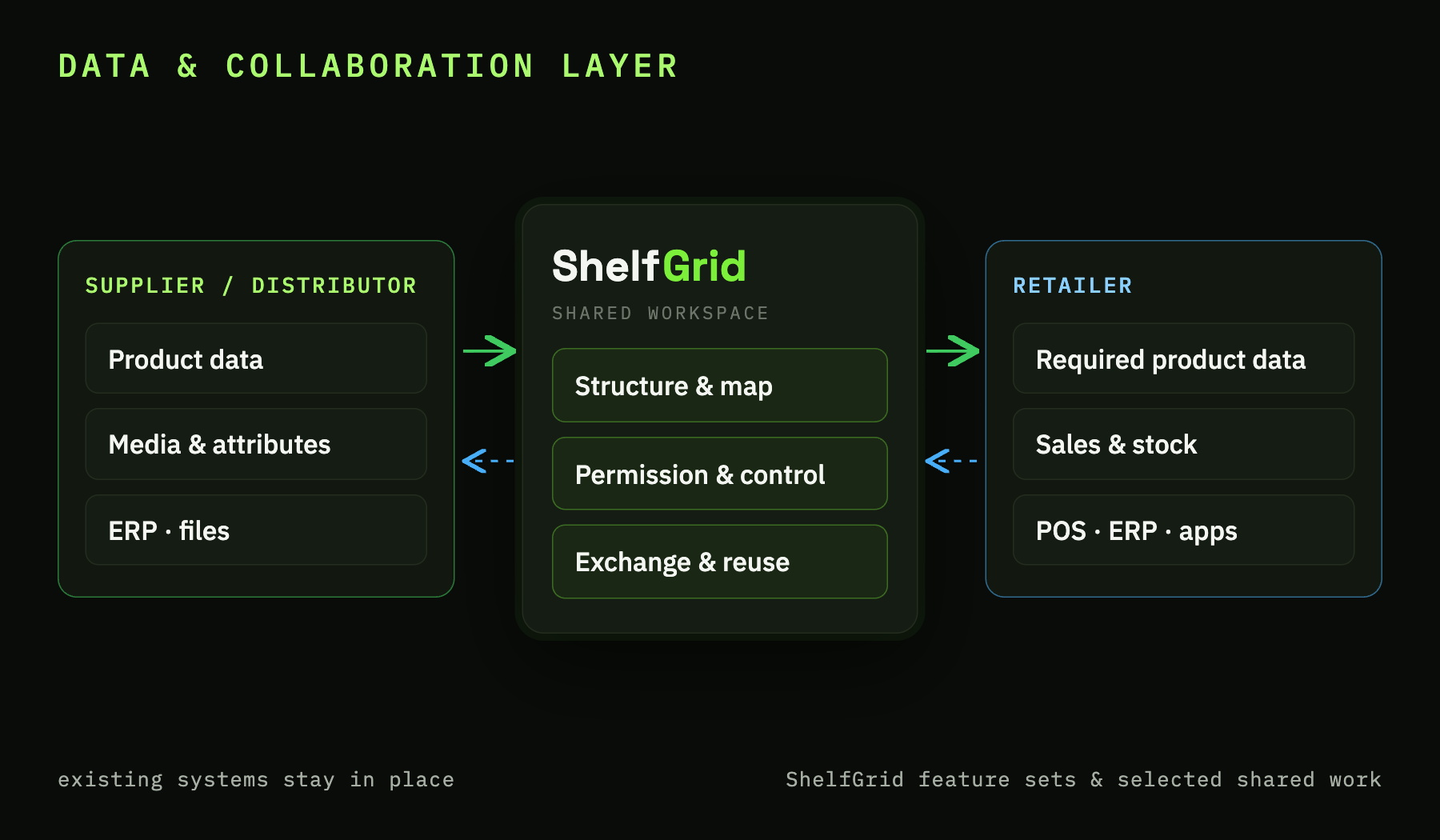
One source. Different retailer requirements.
Connect or import the trusted product record once, then shape the approved output for each retailer without rebuilding the process every time.
Platform · data exchange
Suppliers and distributors can maintain product information once and produce the different outputs retailers require. Retailers can use ShelfGrid as their own supplier data-intake platform, giving suppliers one controlled place to submit product data and imagery. Retailers can also choose to share selected sales, stock or availability data back to authorised suppliers. Existing systems stay in place.

The trading-partner problem
Suppliers maintain one portfolio but repeatedly reshape it for different retailer requirements. Retailers receive many supplier files and versions, then spend time checking, organising and preparing them again. ShelfGrid gives either side a controlled way to run that exchange.
Product, media and agreed commercial information may need different fields, layouts and submission steps for each retailer.
Bring inbound product data, images and follow-up into your own controlled ShelfGrid process instead of monitoring scattered submissions.
ShelfGrid checks required fields, formats, media and retailer rules, then surfaces missing or invalid information for review before approval.
Reuse mappings, keep version context and work from one controlled data exchange process.
Product data from either side
A supplier or distributor can maintain the governed record once and satisfy different retailer requirements. A retailer can use ShelfGrid as its own supplier data-intake platform, define what suppliers must provide and validate submissions against retailer requirements through the Platform before approved data moves on. Each model can stand alone; the wider ShelfGrid applications remain optional.
Connect or import the trusted product record once, then shape the approved output for each retailer without rebuilding the process every time.
Many suppliers. One controlled intake process for product data through your own ShelfGrid supplier data-intake platform. Define your requirements, validate incoming submissions through the Platform and keep status, review and approved data together around your existing systems.
ShelfGrid already supports structured product and media data, controlled imports and exports and explicit supplier access. Retailer-specific mappings, supplier self-service intake, richer validation and automated delivery are being extended or validated.
How exchange works
ShelfGrid receives agreed data from files, APIs, connected systems and authorised participants. The systems that own the source transactions remain authoritative.
Use files, connected systems, APIs and authorised submissions where supported.
ShelfGrid applies required-field, format, media and recipient checks, then surfaces missing or invalid data for review before approval.
Map fields, identifiers, units and retailer-specific layouts without rebuilding the master each time.
Generate or transmit the authorised recipient-specific output and retain the relevant version and exchange context.
Standalone Platform
Keep ERP, POS, WMS, e-commerce and other core systems in place. Use Data Exchange on its own or let the same governed data support ShelfGrid retailer or distributor tools when those applications are useful.
Category, assortment, shelf, planograms, supplier-funded space, store execution and performance.
Explore for retailers →DISTRIBUTORS & SUPPLIERSPlanning, trade assets, retail space, field execution, expiry, returns and performance.
Explore distribution & supply →Retailer-authorised operational data
Where a retailer chooses to share selected sell-through, reported stock-on-hand, availability or other agreed measures, ShelfGrid can make only that scope available to the relevant supplier or distributor. Better evidence can support better replenishment, VSSL or stock allocation, availability, field priorities and selected offer decisions for the retailer's stores. The signals remain contextual evidence rather than unquestioned truth and core ordering, invoicing, POS and stock systems remain authoritative.
Define the products, stores, measures, periods and recipients that may cross the boundary without exposing the wider retail dataset.
Only the selected supplier or distributor receives the agreed operational data under the configured permission scope.
Use the fuller picture to support replenishment, allocation, availability priorities, field action and selected offer decisions where appropriate.
Control, trust & system boundary
Product data can move from the supplier or distributor to the retailer. Selected authorised retail data can move back. Each organisation keeps its wider workspace and data separate, while ERP, POS, WMS, finance and other designated systems continue to own their transactions.
Approved product records · imagery · dimensions · ingredients · nutrition · regulatory data · retailer-specific fields
Authorised sell-through · reported stock-on-hand · availability · agreed product and store measures
Product, e-commerce and regulatory information requires ongoing maintenance. ShelfGrid keeps the governed source ready for revalidation and approved redistribution, including authorised upstream source contributions where that workflow is enabled.
Each organisation retains its rights in the data it provides and remains responsible for its source information.
Supplier grants are explicit and revocable, with finer bilateral controls being extended.
Multi-tenant isolation and role-based access keep organisational environments separate.
Supporting upstream source
Where enabled, authorised brand owners or principals can contribute product and brand information into a distributor or supplier's controlled data process. This is a supporting route for source information rather than a separate public ShelfGrid audience. Upstream self-service submission remains an area being extended or validated.
Descriptions, ingredients, allergens, nutrition, imagery, dimensions, pack information and lifecycle changes can originate with the authorised source.
The downstream supplier or distributor retains the controlled exchange process rather than exposing its wider environment.
Authorised upstream contribution remains maturity-qualified where the self-service workflow is still developing.

Standardise retailer-specific product delivery, centralise supplier data intake or share selected authorised retail signals with the suppliers who can act on them.